

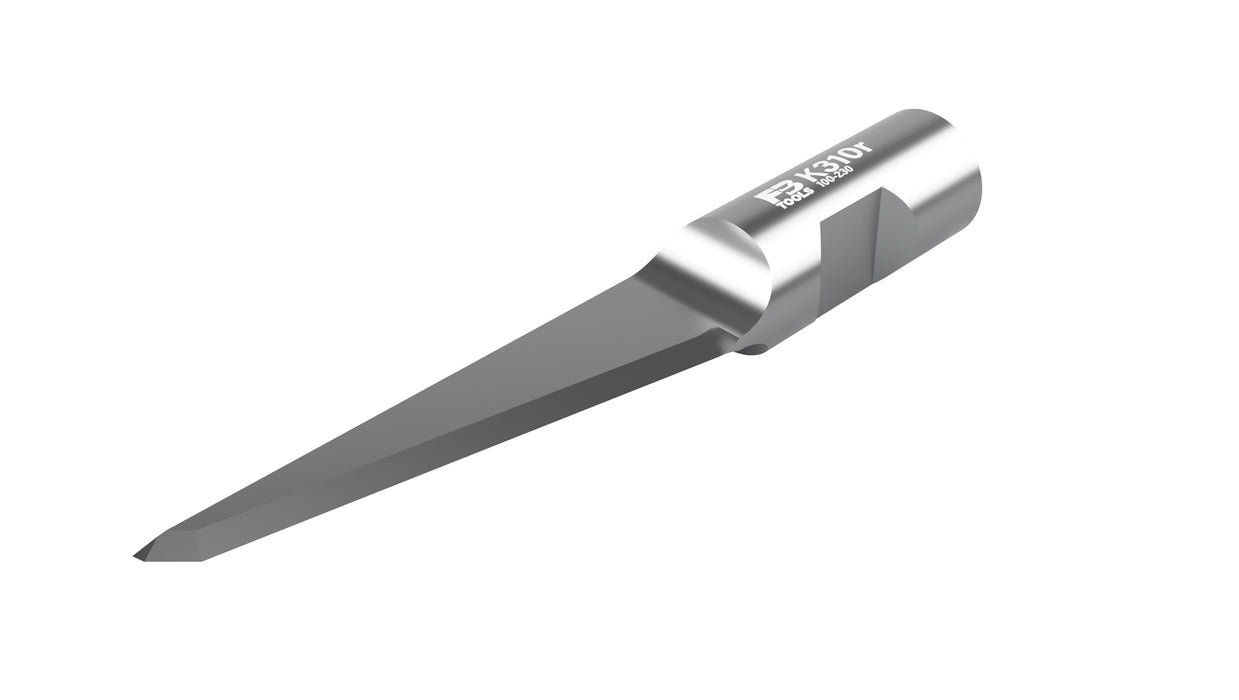
K310r
A direct replacement for the Esko BLD-SR6310, Gerber / MCT G42441626 (42441626), [BRAND? — see Team Q #12] SE627RH, and [BRAND? — see Team Q #13] VTX-K27rh, with no holder modification needed. Single edge oscillating blade for through cutting on Esko and Gerber / MCT flatbed cutting systems.
Sold individually.
Direct OEM replacement
The K310R is a direct equivalent to the Esko BLD-SR6310 and Gerber / MCT G42441626 (also listed as 42441626). Same 6mm round stock form, same geometry, same fit — no toolholder modification required. If you are running SE627RH or VTX-K27rh equivalents, this blade matches those specifications as well. Not sure before ordering? Contact us.
What is through cutting?
Through cutting means the blade cuts completely through all layers of the material, including any backing or liner. The cut piece separates fully from the sheet. Combined with the oscillating action of this blade, the K310R handles thicker and denser materials where a drag blade would deflect or stall. It is not a kiss cut blade.
Fine grain tungsten carbide
Tungsten carbide holds an edge longer than steel in production environments. Fine grain carbide takes a sharper grind and stays sharper longer through repeated cuts in abrasive materials. On a material list that includes corrugated board, sandwich board, honeycomb, and carpet, edge retention matters run to run.
Common questions
How do I know this fits my machine?
If your machine runs the Esko BLD-SR6310 or Gerber / MCT G42441626, the K310R fits. Same goes for the SE627RH and VTX-K27rh equivalents. Part number not listed or not sure? Contact us before ordering.
What materials does it cut?
The K310R is rated for corrugated board, foamboard, folding carton, felt, leather, display board, foam rubber, carpet, sandwich board, honeycomb, sandblasting mask, PET acoustic felt, varnish, and 3M VHB. For thin films or vinyl requiring kiss cutting without penetrating the liner, a different blade geometry is the right call. Not sure which blade fits your application? Contact us.
What do the cutting angle and wedge angle mean?
[TEAM INPUT NEEDED — cutting angle data conflicts across sources. Do not publish this section until Team Question #2 is resolved. Once confirmed, use the Dual-angle FAQ template from the blade reference file.]
How do I know when to replace it?
Cut quality is the signal. If cuts are dragging, tearing, or material is not releasing cleanly, the blade is worn. Dense or abrasive materials like carpet or corrugated board will take an edge sooner than softer stock. When cut quality drops, swap the blade.
Getting the most from your cutting table
A fresh blade is a good start. But if you are going through blades faster than expected, or cut quality has become inconsistent, the blade is rarely the whole story. Cut depth, speed, pressure, and machine condition all affect how long a blade lasts and how clean it cuts.
It is worth asking: When was your machine last serviced? Are your parameters dialed in for this material? Is this the right blade geometry for what you are cutting? Could your operators use time with someone who runs these machines every day?
Flatbed Tools offers machine service, preventive maintenance, operator training, and workflow consulting. If something is not cutting right, reach out. We have probably seen it before.