

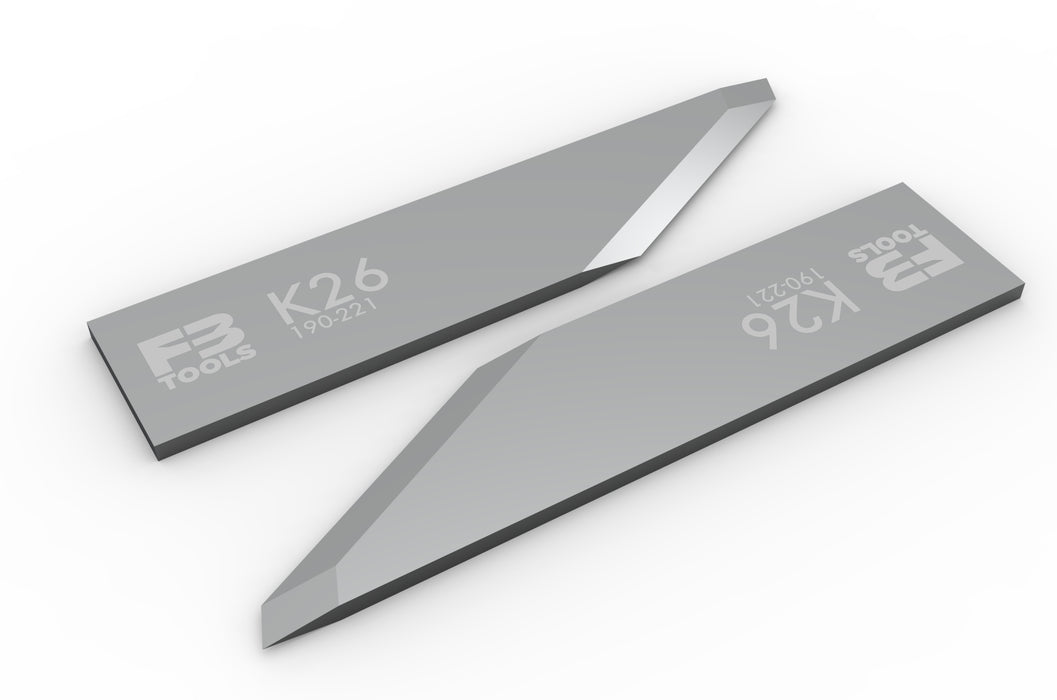
K26
A direct replacement for the Esko BLD-SF426 (i-426 / G42458281), Zund Z26 (3910317), and Gerber MCT SE26 (895026), with no holder modification needed. Single edge drag blade for through cutting on Esko, Zund, Gerber / MCT, Multicam, and Summa flatbed cutting systems.
Sold individually.
Direct OEM replacement
The K26 is a direct form, fit, and geometry match for the Esko BLD-SF426 (also listed as i-426 and G42458281), the Zund Z26 (3910317), and the Gerber MCT SE26 (895026). Drop it into your existing holder. No modification needed.
What is through cutting?
Through cutting means the blade cuts completely through all layers of the material, including any backing or liner. The cut piece separates fully from the sheet. This is a through-cut blade. It is not a kiss-cut blade.
Fine grain tungsten carbide construction
The K26 is ground from fine grain tungsten carbide. Carbide holds a sharper edge longer than tool steel, which matters on abrasive materials like aramid fiber, glass fiber, and carbon fiber. More cuts per sharpening or swap, and cleaner edge quality through the run.
Common questions
How do I know this fits my machine?
Cross-reference the OEM part number your machine currently uses. If it matches Esko BLD-SF426 / i-426 / G42458281, Zund Z26 / 3910317, or Gerber MCT SE26 / 895026, the K26 is your replacement. Not sure? Contact us before you order.
What materials does it cut?
The K26 is rated for felt, leather, display board, folding carton, foam rubber, carpet, fabrics, textiles, polyester fabric, and technical dry fibers including aramid, glass, and carbon. If you are cutting something dense or abrasive and want to confirm it is a good fit, reach out.
What do the two cutting angles mean?
The K26 has a 22° cutting angle and a 65° wedge angle. The 22° cutting angle controls how the blade tracks through the material, reducing drag and helping with clean detail. The 65° wedge angle sets the cross-sectional profile of the edge, balancing sharpness against durability. These are two properties of the same blade, not two different settings.
How do I know when to replace it?
Watch for cut quality changes: dragging instead of cutting clean, tearing at corners, material not releasing cleanly. When the edge is gone, you feel it in the cut. Swap before it costs you material.
Getting the most from your cutting table
A fresh blade is a good start. But if you are going through blades faster than expected, or cut quality has become inconsistent, the blade is rarely the whole story. Cut depth, speed, pressure, and machine condition all affect how long a blade lasts and how clean it cuts.
It is worth asking: When was your machine last serviced? Are your parameters dialed in for this material? Is this the right blade geometry for what you are cutting? Could your operators use time with someone who runs these machines every day?
Flatbed Tools offers machine service, preventive maintenance, operator training, and workflow consulting. If something is not cutting right, reach out. We have probably seen it before.